02 August 2007

Sundog II

Sundog II
Copyright 2007 V1VrV2

This is not the best photo, from a technical standpoint, but I thought I'd share it anyway. I've written about sun-dogs before, so I won't bore you with the details. I love the sight of an airplane's shadow racing along the face of a cloud. It conveys all the speed, power, and utter magic of flight like few other sights. Too bad this isn't video; sights like this are even more impressive when they're moving!

31 July 2007

Learning to Un-Stifle the Muse

Cumulus Rising
Copyright 2007, V1VrV2


Soaring freely through space -- it’s a dream unfulfilled by all but those who fly. As a kid, before I had access to the kind of airplanes that could propel me with essentially unlimited control and three-dimensional freedom, I used to dream vivid flying dreams. Perhaps it was my mind’s way of getting what I couldn’t yet experience in real life.

The dreams were all very similar. Usually, I’d tour my neighborhood at treetop height, suspended in the air with no pressure on my body, and face down. I didn’t have to flap my arms or “swim” -- I just thought about where I wanted to go and I’d slide that direction.

Another variety of dream, more rare, found me suspended high over a field. Suddenly, I’d drop rapidly downward, accelerating at a rate far greater than freefall. Then, nearing the ground, I’d turn and zoom laterally, just a few feet over the ground, laughing with a giddy sense of freedom and fun. I would awake with my skin tingling, and tears in my eyes.

Later in life, as an Air Force pilot, I reveled in the occasional opportunities to zoom up and around clouds-tops, then dive though puffy holes, rolling and pulling and pretending the clouds were mountains and hills. With the visceral need for aerial freedom now apparently satisfied, the flying dreams ceased.

The mind knows what it needs, I guess, but I miss the dreams. They were the ultimate expression of a part of my mind that I wish I could tap into more regularly. It’s the part from which individual creativity, spiritual energy, artistic pursuit, and romance flow. True artists say it’s an unlimited well. It’s a shame I have not learned how to tap it better. My artistic muse works in short, intense bursts, seemingly carefully-controlled and metered. It sometimes seems as if I am allotted a certain amount of inspiration and output per day. Beyond this level lies…what? Desperation? Madness? If I were to fully let go and succumb to my artistic passions, part of me fears I might lose my analytic, left-brain skills and instantly and permanently become some kind of irresponsible, long-haired hippy. When an artistic period hits, I always feel that I must not accept too much of its gift, or I’ll change into someone else, someone who’s incapable of doing rational things like flying airplanes. I know this is a silly thought-process, but it is one that has vexed me for as long as I can remember. This blog continues to be a form of sticking a tentative big toe into the creative waters that spread out before me.

I work sporadically on a book manuscript, begun years ago. Every so often, when I go back and pull it out of its manila envelope, it’s like reading another writer’s work. I’m pleased to find that the writing is passionate and pretty interesting. It has real potential. Yet I’ve long been paralyzed by the prospect of sharing it with the world, for fear of exposing my most private, inner self to outside ridicule and critique. In recent years, by thinking too much about the social consequences and therefore stifling the muse, I’ve allowed some choice opportunities to slide past me. Articles and books have gone unwritten, photos un-taken, loves lost.

I vow, here and now, to begin to reverse that course. I must stop second-guessing the whole process. The math turns out to be pretty simple. The more I fly, the happier I am. The happier I am, the better I write, take pictures, capture moving images on video, and a lot of other right-brain endeavors.

So I’m off to the airport. And I’m inviting my muse along for the ride. Wish us luck.

12 July 2007

Familiar Skies

In 1981 I was a 16-year old high school student living in Delaware. I have to admit that, at the time, I wasn't much interested in the free education being provided to me by the taxpayers of the State. A solid "C-average" student, I excelled in only the subjects which interested me and which seemed to have some relation to what I thought was "fun." My parents were undoubtedly annoyed to see a kid with so much potential squandering his education and hurting his chances at attending an institution of higher learning any more noteworthy than Bartending Academy.

My parents knew that my primary love was aviation. My mother, recognizing an opportunity to motivate me using flying as an incentive, made a stunning offer during my sophomore year: If I brought my grade point average up an entire letter-grade, she would pay for me to attend a two-week Private Pilot sailplane course in upstate New York. I was overjoyed.

Growing up, I had flown in light single-engine airplanes and the occasional helicopter, and I knew from age four that I wanted to be a pilot. Later, in 7th grade, I had been given a 30-minute sailplane ride at a local airport as a birthday present, and I had been in love with the sport ever since. Soaring silently in an engineless airplane, gaining altitude by using the heat of the sun and one’s carefully-acquired skills seemed to be the purest, most unadulterated form of flight. From the moment the glider lifted off the runway, and throughout the rest of that ride, my lifelong desire to be a pilot was reaffirmed a thousand times over.

With the opportunity to actually become a pilot now solely in my hands, I did what I had to do and improved my grades to the required level. And so it was that on a fine June morning in 1981, I found myself in the front seat of a Schweizer 2-33 sailplane, 3000 feet over the Elmira-Corning Regional Airport, in Elmira, New York, receiving my first official sailplane flying lesson from Dale Gustin.
Dale was about 50 years old, friendly, patient, and had a dry sense of humor similar to my own. He taught me takeoffs, straight-and level-flight, turns, climbs, descents, airspeed control, stall recoveries, patterns, and landings. We made three to five flights each day, and I soaked up his instruction like a sponge in water. Just as I was getting used to the routine with Dale, he left for his summer vacation and turned me over to another excellent instructor, Phil Cross, who continued my aerial education with steep turns, Dutch Rolls, coordination exercises, turn-stalls, spins, rope-break procedures and other emergencies, off-airport landings, and covered-panel flying. On my fourth day of instruction, after I did a nice landing on the wide grass runway in front of the soaring school building, he hopped out, patted me on the back and said, "OK, I want you to take a tow up to 2,000 feet and do a pattern by yourself. Just do it the same way you've been doing it for the past few days with me. I smiled and said, "I had a feeling this was gonna happen today..."

My first solo was anticlimactic. I was towed aloft, and followed obediently behind the Piper Super Cub towplane until we reached 2,000 feet above the field. Then I pulled the red release knob on the instrument panel which, with a loud "pop," severed me from the relative security of the tow-line and left me alone to contemplate the empty back seat where my instructor usually sat. I remember noticing that the plane wasn't descending nearly as quickly as usual without all that dead weight in the back, and I enjoyed the feeling of total control over my situation that soloing gave me. I took the experience very seriously, aware at every moment of the huge, adult-size responsibility that had been given to me, and of the scrutiny being paid to my performance from many sides. It was one of the great and defining moments of my life.

My landing was good — not perfect or magical — but good. Phil, in keeping with generations of aerial tradition, grabbed a big pair of scissors and snipped off the back of my shirt. On it, he wrote my name, the date, signed his name, and drew a crude picture of a sailplane. It was the best piece of artwork I'd ever seen, and the grin on my face lasted for days.

Throughout the following week and a half, I learned more maneuvers and polished my new skills, both solo and with my instructor. My confidence grew with each flight. Within a half-dozen flights, I was cleared to fly the school's single-seat 1-26 gliders, which felt like fighter planes after the docile two-seat trainers. I especially enjoyed the occasional opportunities to take a 1-26 up for some "ridge flying," staying aloft for hours at time by using the upslope wind that blew along the faces of the local hills.

My Private Pilot check flight came quickly, and before I knew it, I was a newly-minted, licensed glider pilot. My first passenger was my sister, who rode with me the morning after my checkride. She enjoyed the experience almost as much as I enjoyed providing it for her. I was as happy as I could be. That afternoon, with my parents and sister, I left Elmira, New York behind, never imagining the circumstances under which I would see it next.

Years went by. I immersed myself in college, was commissioned as a Lieutenant in the US Air Force, flew fighter jets and became a military flight instructor, and later became an airline pilot. I continued to fly small airplanes of various types, but hadn't flown a sailplane for several years. With the passage of time, I now rarely thought about my soaring school experience in New York during that long-ago summer.

June 1999: As a First Officer with United Airlines, I was flying an Airbus A320 from Chicago to Boston. Our 140 passengers were just finishing breakfast, and the flight attendants were beginning to collect the dishes. The Captain and I had just been discussing movies we'd seen recently, when I glanced out the window, down and to my right.

There, six miles below, bathed in the bright morning light, was the entire Chemung Valley, laid out like a diorama. The Elmira airport runways were clearly visible, and I could easily see the old Schweizer Soaring School building. A half-mile to the south, the imposing mountain ridge along which I used to soar looked like nothing more than a tiny crease in the landscape. To the east, I could just make out the roadside motel where I'd stayed, and the restaurant where I'd eaten breakfast each morning so many years before. Viewing it all from this vantage point really emphasized just how far I’d come. I was seeing, in one glance, the entire extent of my early flying world — a world which, at the time, was vast beyond words.

A flood of memories returned. I remembered Dale and Phillip, my instructors. I recalled in vivid detail the excitement and adrenaline of my first spin, which Dale talked me through in his patient, laid-back style, even as the earth became a rapidly rotating brown-green blur in our windscreen. I remembered the airport dog, Skippy, who spend his days snoozing on the porch of the flight school, waking only to receive an occasional pat on the head from a passing visitor.

But mostly I remembered the feeling of utter possibility in the air. As each day passed, I was becoming a pilot, right in front of my own eyes. My earliest childhood dream had been to fly an airplane, alone and high across the tapestry of that great open space. Before I knew anything about the physics of how airplanes flew or what was involved in learning to do it, I knew that the third dimension held excitement. While learning to fly sailplanes, I was confirming my impressions and living that dream. I’d lived the experience of flying so many times in my imagination that mustering the courage to do it was not even an issue. I was simply executing my pre-destined flight path through life. And I knew that this first step into the sky would lead me on to more rewarding, challenging paths, which would lead to even more rewarding ones, and so on. And I was right.

A bright glint of sun, reflected off the cockpit window, slid over my eyes and brought the present back into focus. The jet was automatically turning — banking to intercept the next airway on our journey to Boston. The landscape slowly rolled by, and a minute later, the familiar valley had receded behind us, and out of view.

Someday I’ll return to that airport, and walk around on the grass, and maybe pat Skippy’s grandchildren on the head. I want to see if another generation of pilots is setting in motion the special experiences that will form the fabric of the rest of their lives. Until I return in person, it’s nice to know that I can find it from my new vantage point any time I fly between Chicago and Boston. The world connects us to our past and future in strange, wonderful, and unexpected ways. I’m looking forward to the next one. Maybe someday I’ll look down from an orbiting space station, catch a glimpse of the eastern United States and say, “I used to fly airliners down there...”


28 June 2007

"Of Flight and Life"

Westward Track
Copyright 2007 by V1VrV2


"I grew up as a disciple of science. I know its fascination. I have felt the godlike power man derives from his machines -- the strength of a thousand horses at one's fingertips; the conquest of distance through mercurial speed; the immortal viewpoint of the higher air. I have sensed the harmony of muscle, mind, and mechanism which gives the illusion of life to substance until levers move with thought as hand or foot, until the rhythm of an engine is geared to the beat of one's own heart, and wing in turning flight seems an extension of one's own body."


--Charles A. Lindbergh, "Of Flight and Life"


Solitary Cu
Copyright 2007, V1VrV2


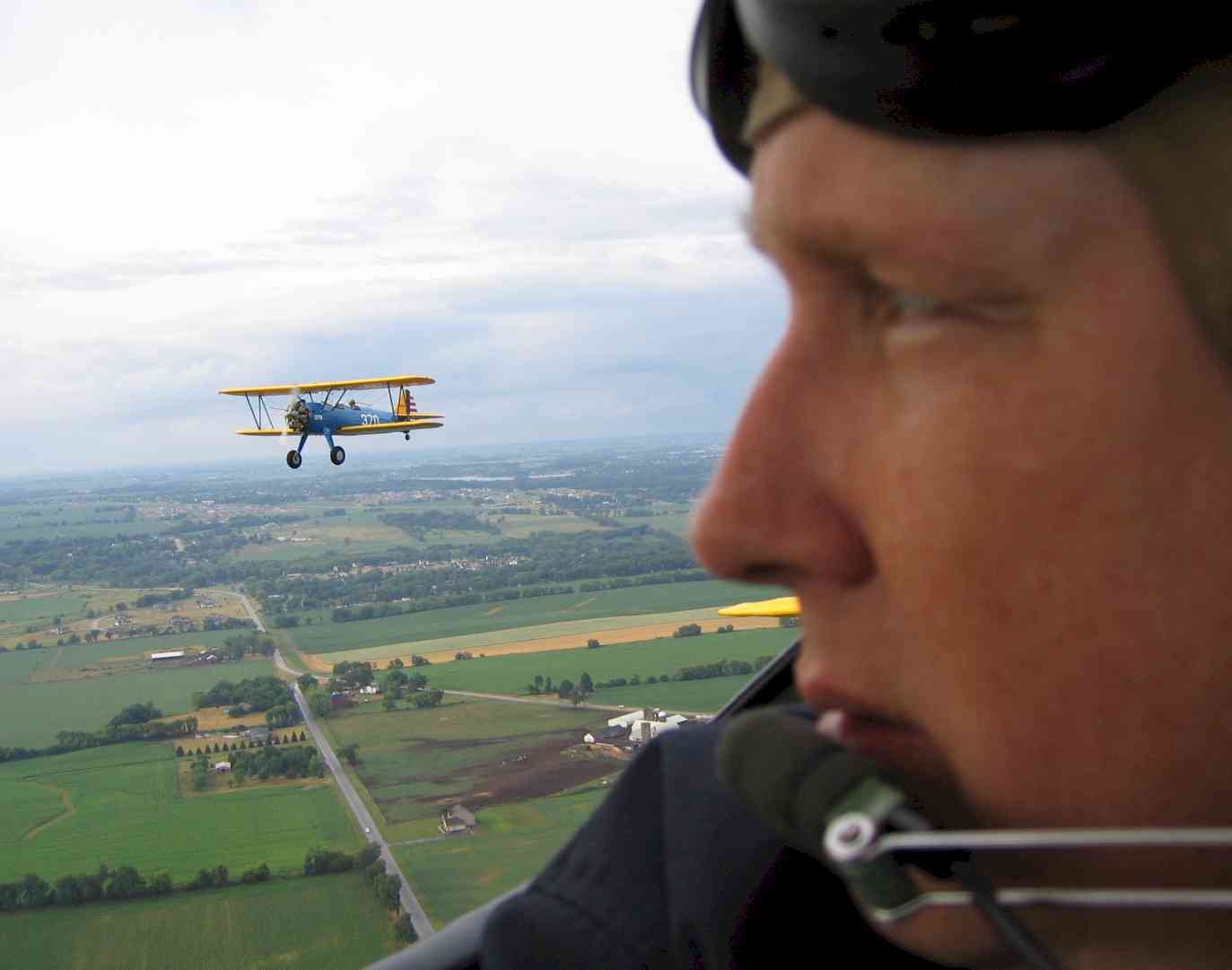
Stearman Salute
Copyright 2007 by V1VrV2

09 June 2007

Thunderstorm over Dallas

Majesty
Copyright 2007, V1VrV2

This photo was taken northwest of Dallas. A line of wicked weather was moving through the DFW metroplex. From my vantage point fifty miles to the south, the tops of the storms, crimson-lit by the setting sun, looked almost peaceful. I think back to the times in my military flying career when we would circumnavigate such areas with no onboard radar, and therefore no clue. While flying in high cirrus, we'd often ask the controllers to point us in the best direction -- and since the controller's weather-radar depictions were primitive at best, we'd occassionally find ourselves skirting pretty close to monsters like this. These days, by comparison, it's relatively easy to remain clear of the big red and yellow blobs on a modern weather radar screen. The radar is only an aid, though. Sometimes, storms don't contain enough moisture to show up well on the radar, and you have to use your eyeballs, your gut feelings, and your experience to stay out of trouble. This is one of the reasons why there won't be autonomous, un-piloted airliners. At least in our lifetimes...

15 May 2007

Mount Ranier Sunset

Evening Light
Copyright 2007 V1VrV2


Every so often, when you’re flying, you're granted a bit of real glory. On a recent flight into Seattle, it happened to us. No one on board was necessarily looking for it or expecting it. It was the kind of thing that made passengers get up and move over to the left side of the airplane, despite the illuminated Seatbelt sign. In this case, they were forgiven. I can assure you that the faces of the pilots were pressed against their windows, too, along with my camera, of course.

Just a quick reminder to keep your eyes open. Look for glory. It’s literally everywhere.

12 May 2007

Aerial Border Patrol

Calexico/Mexicali
Copyright 2007, V1VrV2


They say the loftier your view, the less you can see man's impact on the earth. Astronauts say they have to look very carefully to see any of our scars, geopolitical lines and other influences. From 39,000 feet up, though, some borders are painfully obvious.

This is the U.S.-Mexico border between the cities of Calexico, California (left) and Mexicali, Mexico (right). Mexicali's population is over 800,000, in contrast to the approximately 30,000 residents of Calexico.

It's fascinating to study this image. It clearly shows what some in our society are loathe to admit: Our neighbors to the south are practically stumbling over themselves in an effort get over here. The way many of their cities spread out along the border, filling every acre of land right up to the fence line, is a metaphor for what their society is doing. Whether or not a tall border fence is ever erected along the Mexican border, immigrants will try to cross, whenever and however they can.

Another fascinating contrast, only partially apparent in this photo, is that between the color and vibrancy of the land itself. U.S. soil is rich, the crops green and lush. Mexican soil, mere hundreds of feet away, is dry, brown, and appears to be much less productive. Culture? Agricultural technology? Who knows? (I'll try to get a photo that better illustrates this phenomenon, and post it here sometime soon.)